
August 29, 2026
7 min read
Andreas Georghadjis LLC
The residence-based framework under the Civil Registry Law, the fast track for skilled professionals, and how an applicant should prepare
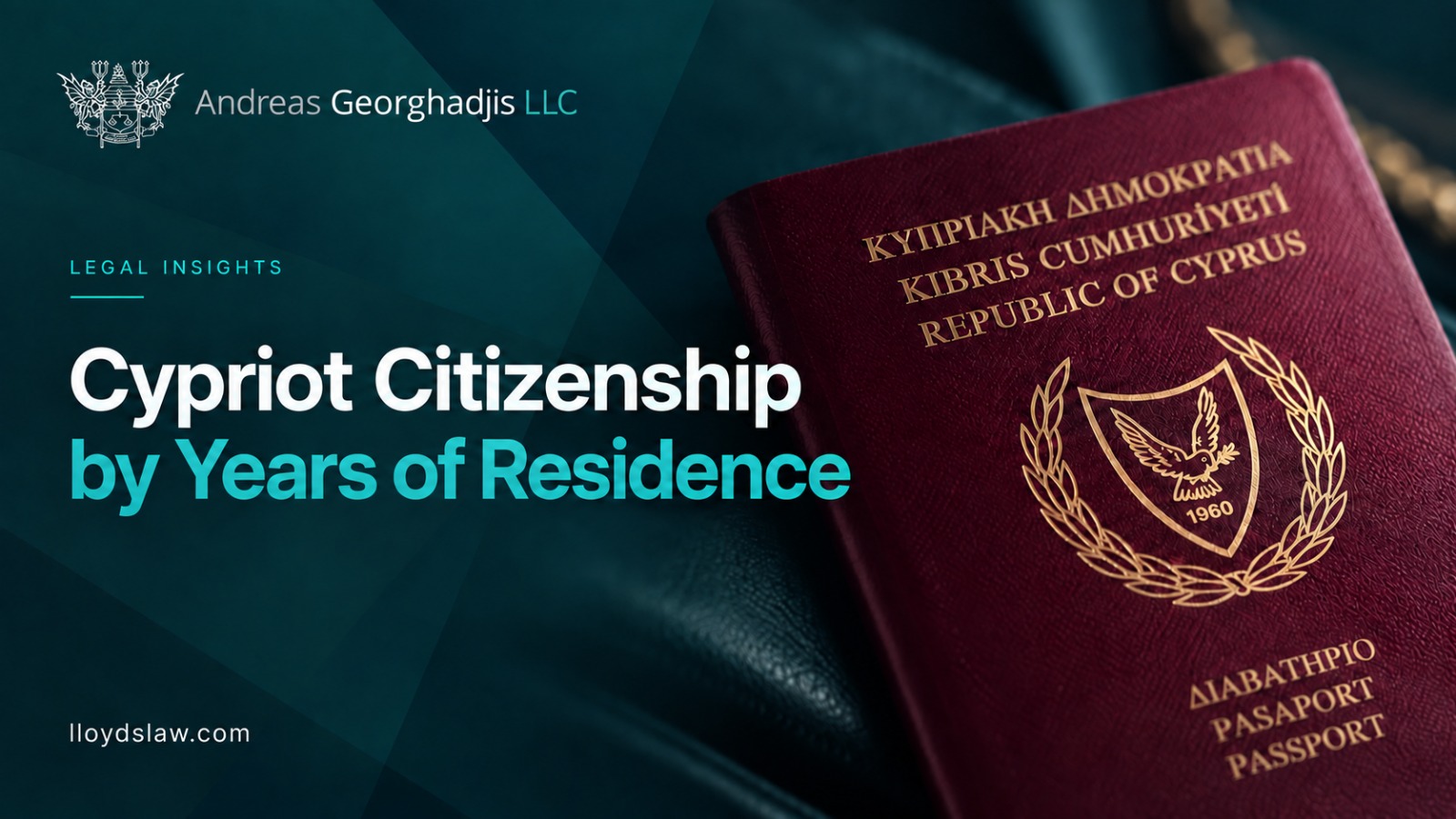
A Cypriot passport is a passport of the European Union: it carries the right to live, work and study in any of the twenty-seven Member States.
This article sets out the current requirements, explains the points on which applications most often fail, and describes how a prospective applicant should organise their affairs in the years before applying.
The legal framework
Naturalisation is governed by the Civil Registry Law of 2002 (Law 141(I)/2002), as amended by Law 149(I)/2023. Article 111 sets out the ordinary route, based on years of residence; Article 111B provides a shortened route, "fast-track route" for highly skilled employees of designated companies and their families. The grant of citizenship under either article is discretionary: an applicant who satisfies every criterion acquires a strong claim, not an entitlement, and the quality of the file therefore matters as much as the underlying facts.
The ordinary route: 7+1 years
An adult applicant must have resided lawfully and continuously in Cyprus for the 12 months immediately preceding the application, and, within the 10 years preceding that final year, must have accumulated at least 7 years of lawful residence. The seven years need not be consecutive. Absences not exceeding 90 days in total in any year do not interrupt residence, whether during the 7-year accumulation or the final 12 months. In practice, therefore, an applicant who has lived in Cyprus for 8 years, travelling abroad for up to 3 months a year, will meet the residence test.
The residence must be lawful in the specific sense the law intends. Only time spent under a residence permit that counts for the purpose is credited: periods spent as an applicant for international protection or as a beneficiary of temporary or subsidiary protection are excluded, as is any period during which a permit had lapsed. The day of arrival in Cyprus is counted as a day of presence; the day of departure is not. The Migration Department verifies the figures against the applicant's own record of arrivals and departures and against border data, and discrepancies are among the commonest reasons for refusal.
The fast track for skilled professionals
Article 111B shortens the residence requirement for individuals employed as highly skilled personnel by companies designated by the Council of Ministers, principally companies of foreign interest registered with the Business Facilitation Unit, together with Cypriot shipping, high-technology, innovation and pharmaceutical companies. Such an applicant must still complete the final 12 months of continuous residence, but the cumulative residence required within the preceding 10 years is reduced to just 4 years for an applicant with Greek at level A2, and to 3 years for an applicant with Greek at level B1 or with a secondary or university qualification obtained in Greek.
Applications under Article 111B are examined on an expedited basis at a fee, with a maximum processing period of 8 months. Family members may apply at the same time, on the same shortened residence periods, without their periods of residence having to coincide with those of the principal applicant.
| Route | Greek level | Cumulative residence (within prior 10 years) | Total incl. final 12 months | Expedited |
|---|---|---|---|---|
| Ordinary (Art. 111) | B1 | 7 years | 8 years | No |
| High-skilled (Art. 111B) | A2 | 4 years | 5 years | Yes |
| B1 or Greek-medium diploma/degree | 3 years | 4 years | Yes |
Scroll the table sideways
The two examinations
Every applicant must hold two certificates, and they are the part of the process most frequently underestimated.
Greek language. The applicant must produce a certificate of proficiency in Greek at level B1 under the Common European Framework (or A2, for the four-year fast track) issued following written and oral examination. The examinations of the School of Modern Greek of the University of Cyprus are held twice a year and places are limited and fill quickly. A secondary school diploma or university degree obtained in an institution where Greek was the language of instruction is accepted in place of the certificate.
Knowledge of Cyprus political and social reality. The applicant must pass, with a mark of at least 60%, an examination on the basic elements of the contemporary political and social reality of the Republic, set by the Examinations Service of the Ministry of Education. It is held twice a year, is conducted in Greek, and covers the political system and institutions, modern history since 1960, geography, economy, customs and everyday matters. The syllabus is basic; the difficulty lies in reading the questions in Greek under examination conditions, and an applicant with a fresh B1 certificate should not assume the examination will be a formality.
Good character
The applicant must be of good character. The law defines the concept by exclusion, and the exclusions are wide. An applicant will not be treated as of good character if he has been convicted of an offence punishable by imprisonment of five years or more, or is under indictment for an offence punishable by three years or more; if he appears on a United Nations or European Union sanctions list or is the subject of a warrant under European or international law for a serious offence; if he has entered or remained in the Republic unlawfully or breached immigration law; if he has entered or left the island through the ports or airports of the occupied areas, or has been involved in the administration of the occupied areas or in unlawful dealings with property there; if he has acted or spoken in a manner showing disloyalty to the Republic or its constitutional order; if he poses a threat to public order, public safety or national security; or if he has engaged in conduct that is morally reprehensible or socially unacceptable.
A clean criminal record certificate from the Republic, valid for six months, accompanies every application.
Andreas Georghadjis LLC has advised on Cypriot citizenship and immigration matters for over 30 years and handles naturalisation applications from the planning stage through to the oath of allegiance: assessment of eligibility and of the residence record, guidance on the examinations, preparation and submission of the application, and correspondence with the Department during examination. Enquiries may be addressed to the firm's Limassol or Ammochostos office.
This article provides general information on the law in force at the date of publication and does not constitute legal advice. Each application should be assessed on its own facts.